Your Agent Is a Tiny Company (And You're the CEO)
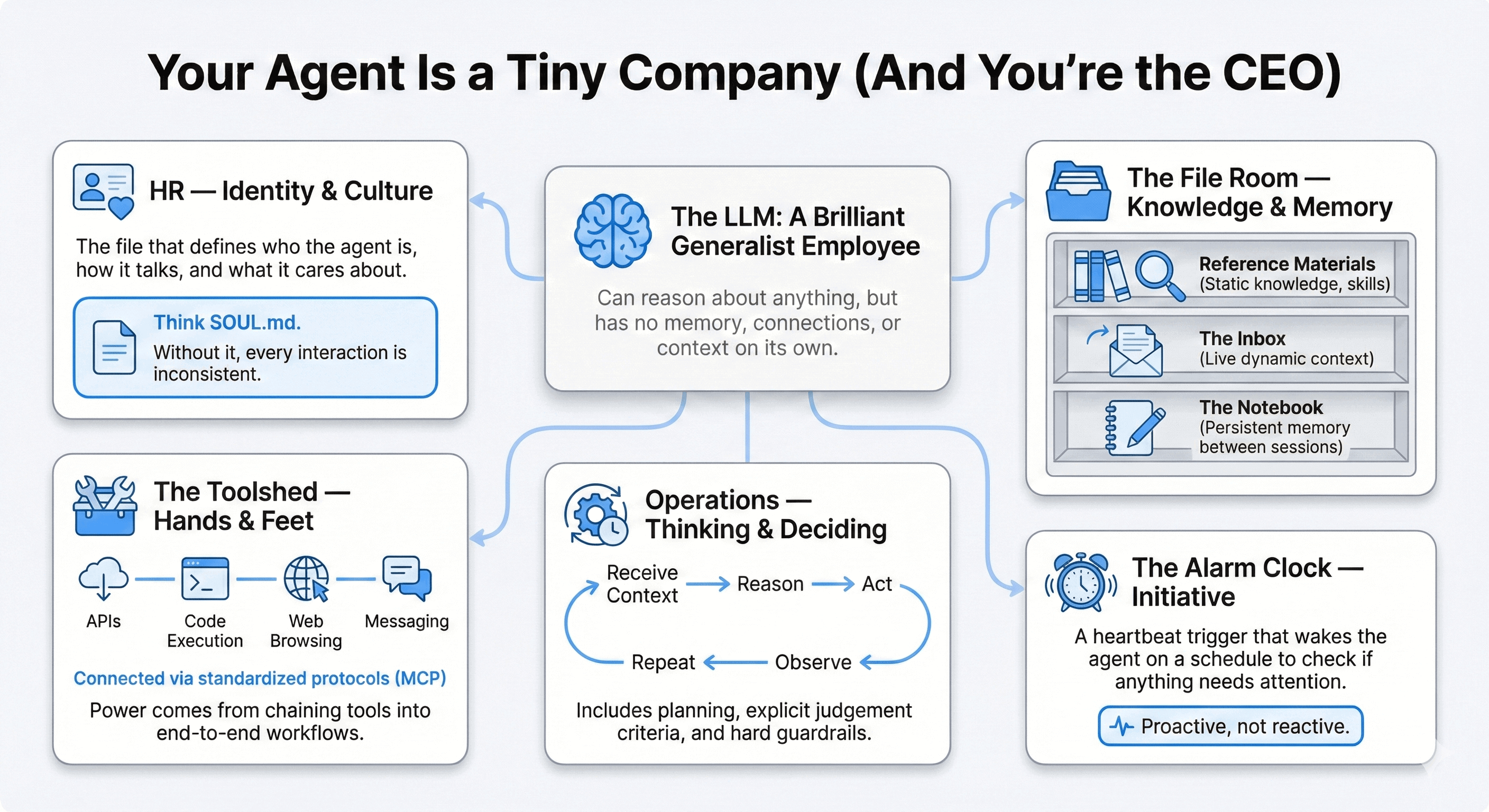
Everyone's talking about AI agents. Most explanations make them sound like magic. They're not. An agent is just a tiny company — one with a single employee who happens to be brilliant but has no memory, no connections, and no common sense until you give them all three.
Once you see it this way, everything clicks.
The org chart of one
Imagine you hire the smartest generalist in the world. Day one, they show up to an empty office. No files, no phone, no address book, no to-do list. They can reason about almost anything — but they know nothing about your business, can't talk to anyone, and forget everything the moment they leave the room.
That's an LLM.
An AI agent is what happens when you build an entire company around that person: an office, a filing system, a phone, a calendar, a set of standard operating procedures, and a manager who checks in regularly. The genius doesn't change. The infrastructure does.
This is the most important mental shift in AI right now: you're not building a smarter model. You're building a better company around the model you already have.
Five departments every agent needs
A real company has departments. So does an agent. Here are the five that matter.
1. HR — Identity and culture
Most companies have a culture doc. Your agent needs one too.
This is the file that says: Here's who you are. Here's how you talk. Here's what you care about. OpenClaw, the open-source agent framework, literally calls this SOUL.md — a Markdown file loaded into every conversation. It's the difference between a generic assistant and one that feels like it works for you.
Identity sounds soft. It isn't. An agent without a defined identity will answer customer emails in a different tone every time, use the wrong level of formality with your boss, and hallucinate company policies. Culture isn't a nice-to-have. It's quality control.
2. The file room — Knowledge and memory
Your brilliant employee can reason about anything — if you put the right documents on the desk. The file room is where you solve that problem, and it has three shelves:
Reference materials — the stable stuff. Product specs, brand guidelines, pricing rules, standard procedures. You organize these once and update them occasionally. In agent terms, these are your static knowledge files and skills — modular instruction sets the agent loads on demand, like an employee pulling the right binder off the shelf for the task at hand.
The inbox — the live stuff. The email that just arrived, the Slack thread that's blowing up, the calendar invite for tomorrow. This is dynamic context, and the hard part isn't getting it — it's filtering it. A great employee doesn't read every email in the company. They read the ones that matter right now.
The notebook — what the employee learned yesterday. LLMs have no memory between conversations. Zero. So you build memory externally: a daily log of what happened, a curated file of long-term learnings, and a search system that retrieves relevant memories when needed. OpenClaw does this with flat Markdown files and SQLite. No fancy infrastructure. Just files that persist what the model can't.
The file room is where most agent projects succeed or fail. Not because the AI can't think — but because nobody built the plumbing to get the right information to the right place at the right time.
3. Operations — Thinking and deciding
This is the department where work actually gets done. The employee reads the brief, thinks about it, makes a plan, and executes step by step.
In agent terms, this is the agentic loop: the model receives context, reasons, decides to either respond or take an action, sees the result, and reasons again. It's a cycle that can repeat dozens of times for a single request. "Prepare me for tomorrow's meeting" might mean: check the agenda, pull last quarter's numbers, scan recent email threads with the attendees, draft talking points, and flag two open risks — all in one loop.
But operations without management is chaos. Your employee needs three things beyond raw intelligence:
- A planning instinct — the ability to decompose "do this big thing" into a sequence of small things.
- Judgement calls — explicit principles for what "good" looks like, because unlike humans, agents don't have intuition. You have to write down what you'd normally just feel.
- Guardrails — hard limits on what the employee should never do, enforced at the infrastructure level. You don't put "please don't steal" in the culture doc and hope for the best. You lock the safe. Smart agent architectures sandbox tool execution, restrict permissions per session, and treat prompt injection as a reality to contain, not a bug to fix.
4. The toolshed — Hands and feet
A strategist who can't send an email or open a spreadsheet is useless. Tools are what let the agent do things: call APIs, run code, browse the web, read files, send messages.
The interesting evolution here is standardization. The Model Context Protocol (MCP) is becoming the USB port of agents — a standard interface that lets any external service expose its capabilities to any agent. Build a tool once, and it works everywhere. This is how tool ecosystems scale: not through bespoke integrations, but through shared protocols.
The real power isn't any single tool. It's chaining: the output of one action becomes the input of the next. Check inventory → calculate reorder quantity → draft purchase order → send for approval. That's not four separate tasks. That's one workflow the agent orchestrates end to end.
5. The alarm clock — Initiative
Most assistants sit and wait. A great employee doesn't.
The simplest and most powerful pattern in agent design is the heartbeat: a scheduled trigger that wakes the agent up at regular intervals to check a to-do list. Anything need attention? Act on it. Nothing happening? Go back to sleep.
OpenClaw runs this every 30 minutes. To keep costs down, it checks cheap signals first (new emails? calendar changes?) and only fires up the LLM when something actually needs thinking. Proactive autonomy turns out to be just a cron job — a timed trigger that's been around since the 1970s. The magic isn't the mechanism. It's what happens when you combine a timer with an entity that can reason.
Why the metaphor matters
The tiny-company model isn't just cute. It's useful — because it tells you where to look when things break.
- Agent gives inconsistent answers? → HR problem. Your identity file is vague or missing.
- Agent doesn't know something it should? → File room problem. The knowledge exists but isn't connected.
- Agent does something dumb? → Operations problem. Your judgement criteria or guardrails aren't explicit enough.
- Agent can't complete tasks? → Toolshed problem. It lacks the integrations it needs.
- Agent only works when you poke it? → Alarm clock problem. You haven't given it a heartbeat.
This diagnostic lens is the real gift of the framework. Agents fail for structural reasons, not intelligence reasons. The model is almost always smart enough. The company around it is what needs work.
The CEO's job
If the agent is a tiny company, then you — the person building and configuring it — are the CEO. And like any CEO, your job isn't to do the work yourself. It's to:
- Define the culture — write the identity file that shapes every interaction.
- Build the file room — connect the right knowledge and build the memory system.
- Set the operating principles — make judgement explicit and guardrails hard.
- Stock the toolshed — give the agent access to the systems it needs.
- Set the alarm clock — decide what the agent should proactively watch for.
The model is a commodity. It will keep getting cheaper and smarter. What won't commoditize is the operating environment you build around it — the knowledge, the judgement, the integrations, the workflows. That's your moat.
You're not prompting a chatbot. You're running a company of one.
Make it a good one.