Grok Bot now has an official changelog
You can now track every new feature, improvement and fix as it ships
The release pace is already wild and lot of new features landing every update
https://t.co/FEbc0wacur
Signals
Things I stumble on — sometimes interesting, sometimes relevant, sometimes just funny.
October 2026
Oct 5
September 2026
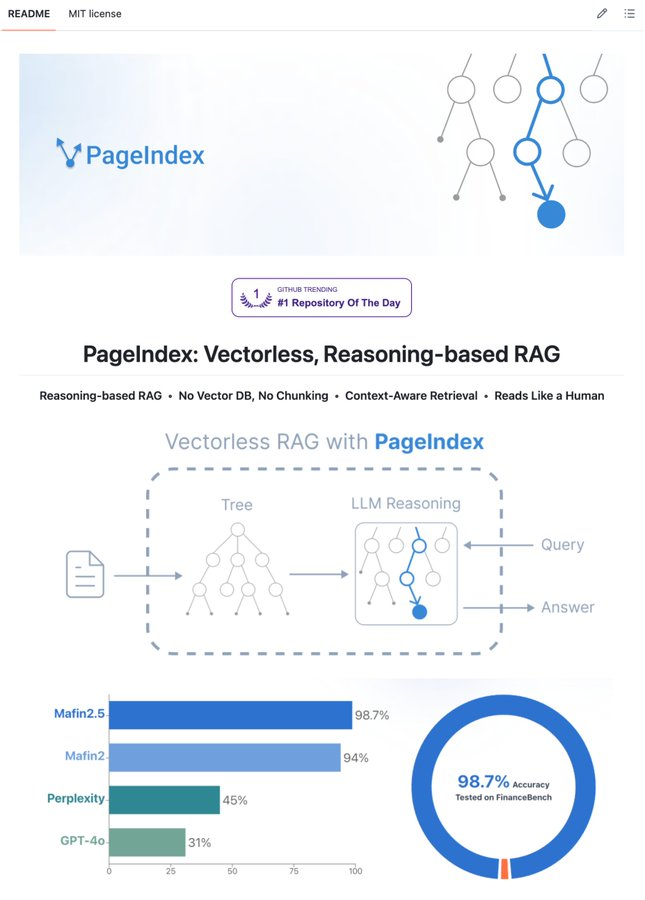
The entire RAG industry is about to get cooked.
Researchers developed a new RAG approach that bypasses almost everything traditional RAG depends on.
- No vector DB
- No data embeddings
- No chunking
- No similarity search
It's called PageIndex.
Instead of splitting your documents into chunks and loading them into Pinecone, it creates a tree index that lets the LLM reason through them like a human reading a book.
98.7% on FinanceBench. Outperforms every vector RAG on the leaderboard.
100% free. Open source.
One-command tool that exposes a local server as a public HTTPS URL on Cloudflare’s edge. No account, DNS, or inbound ports required. Includes JSON output for coding agents and ephemeral trycloudflare.com hostnames.
Dev ToolsProductivitytry.cloudflare.com · Sep 19
public speaking is a weird catch-22: it's hard to feel confident without evidence that you can be good at it, but it's hard to get that evidence if every talk feels like torture.
the first time you give a talk will be the worst version of that talk. you are learning, live, how each part lands with the audience, which means you are working out the content while also trying to improve your speaking skills.
rehearsing in front of the mirror ahead of time helps but only to an extent. the reason public speaking is hard is because it feels deeply unsafe. practicing without stakes is not really practicing the hard part. you need exposure to the vulnerability of being perceived.
this is why, if someone on my team is working on their public speaking, I find it helpful to contrive situations where they need to give the same talk repeatedly (like 5+ times). they are usually stressed out for the first 1–3 times. but with each rep, they get more comfortable with their delivery. by the 5th time they can start to have fun with it, workshopping new riffs on the fly. the confidence in the content allows them to settle into the delivery.
I learned this accidentally when I had to deliver a product training in all 8 of Dropbox's global offices. I gave the same talk, which included a live Q&A, about a dozen times. I went from very terrified of public speaking to much, much more comfortable with it. and it gave me the confidence that I could improve even more if I kept finding reasons for people to hand me a microphone and put me in front of a room.
if you're trying to come up with a talk you could give 5+ times, work backwards from something that others in your organization (or at other companies) would benefit from learning and that you'd be well-positioned to teach them.
I wrote more about this here: https://t.co/GEcmd68R7k
Practice-based public speaking training with games, live classes, and cohort courses for speaking clearly and confidently under pressure.
Productivityultraspeaking.com · Sep 16
Most people don't know this about me, but I've long had really bad stage fright. I'd get extremely nervous giving talks, speaking in big meetings, being in the spotlight. It's still a problem, but it's gotten a lot better in the last couple of years.
For those struggling with this too, three things that made a real difference for me:
1. Ultraspeaking: https://t.co/cNzDr5ra2c. It's a unique approach to building confidence in public speaking, in a fun and low-stakes environment.
2. Beta-blockers: https://t.co/gmXnwzUOxi. It quiets the body's physical anxiety so you can focus on what you actually want to say. Do your own research (and talk to your doctor), but it's felt like a miracle.
3. This advice from @tobi below, plus a few other mantras I repeat in my head that shift my mind from worst case to best case:
- "Look what I get to do!"
- "Don't perform. Be yourself."
- "Find the joy in it."
- "Dare to be dull."
- "I love public speaking!" via Tobi
If you've struggled with this too, anything you've done that has made a big dent? In case it may be helpful to others.
@signulll The turning point is usually when the company stops protecting the past and starts building for what’s next.
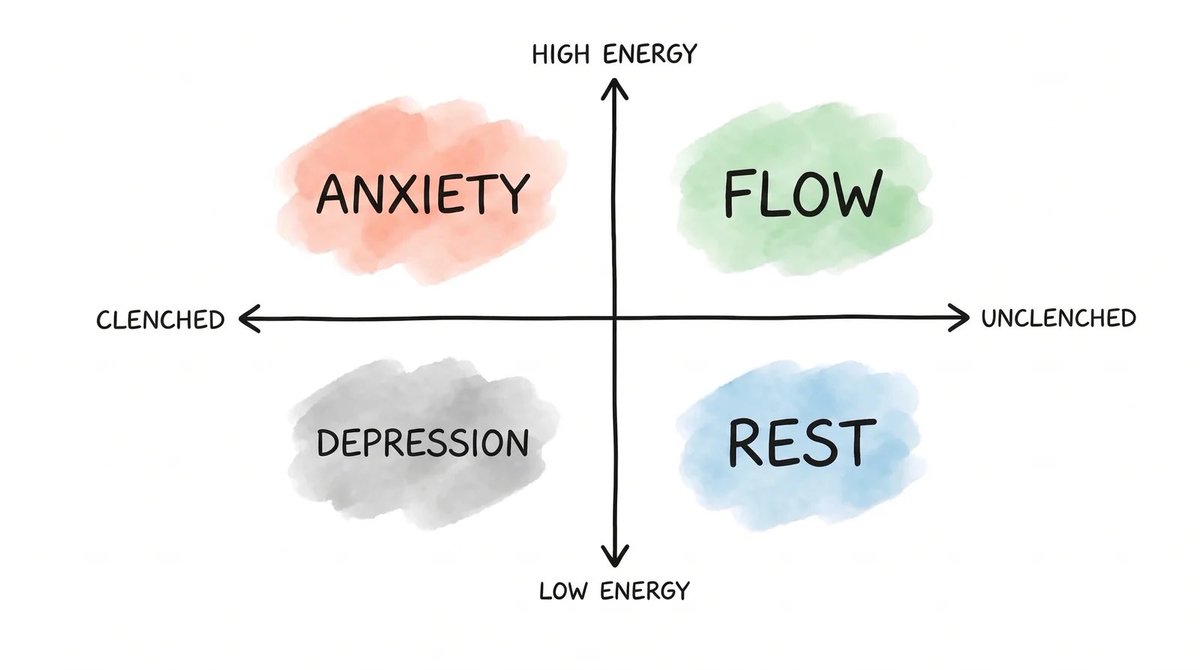
Oh and I like this 2x2 https://t.co/kLwY73ZzpZ https://t.co/RivOz8janB
The best founders in the world like @elonmusk or @tobi “go ultra-hardcore on deletion and simplification.”
Luca Ferrari says Bending Spoons employs this idea of “Relentless Simplification” across their businesses:
“Humans have a tendency to add complexity and do things that destroy value.”
“If you leave an organization, almost any environment unattended, and you don't provide guidance in this regard, it will tend to become more complicated. People will add parts. It could be expanding a team or adding a step to a process, or adding an entire new process. If it's a product, adding a feature to the product. New rules. It applies to almost any human endeavor.”
“People tend to add pieces, they very rarely remove pieces.”
“If you don't make a conscious effort to achieve simplicity, and avoid this increasing value-destroying complexity, that's how we got to our modern society with all the bureaucracy and complicated regulation.”
“We have this principle whereby we ask everyone who works here, every time someone is suggesting that we should be adding complexity, the burden of proof is on those making that suggestion. The people who support the thesis that we shouldn't be adding complexity don't need to prove it. They just have to raise a flag and say, ‘I don't think we should.’ The burden of proof is on those who want to add complexity.”
“The other part of relentless simplification is that we want people to be on the lookout for existing complexity and suggest that we should remove it.”
 Watch on X
The only businesses left to build:
1. AI native service firms
2. Offline businesses
3. Distribution (media, community, audience)
4. Proprietary datasets
5. Domain specific harnesses (the agent that runs one industry's work)
6. Robotics and physical AI
7. Physical products with a fan following
8. Compute and energy
9. Health, longevity, and care
10. Marketplaces and social networks (for people and agents)
11. Real assets (property, equipment, land, infrastructure)
12. Vertical agents
13. Security
your product is only as smart as the data it can reach.
make your product smart. unleash your cow. https://t.co/Uck61X5XIW
 Watch on X
Powerful personal task manager for iOS, iPad, Mac, and Android. Lists, projects, checklists, tags, locations, Smart Lists, and sync via iCloud, Apple Reminders, Dropbox, Todoist, Toodledo, Fastmail, or CalDAV. One-time purchase on iOS, no subscription.
Productivity2doapp.com · Sep 8
Retailers running shopping agents on Claude have seen carts up to 35% larger and shoppers 60% more likely to complete a purchase.
See our blog to learn more about the architecture, latency & cost techniques, and eval practices:
https://t.co/lAgsVD5JSL
Sep 1
August 2026
WebMCP is SUPER cool!!
All app builders should implement this in their web apps
Showing you what it is in my open source app https://t.co/49jas17LTv https://t.co/WKeKYljzJF
 Watch on X
Patterns I noticed in successful people in my life:
• People think they’re insane
• They’re relentless at follow up
• They reply to emails in one sentence
• They are so high agency it’ll rip peoples faces off
• They understand the enormous value of pattern recognition
• They don’t give a flying f*ck about people’s opinions
• They don’t network and let their work do the work
• They have confidence that comes from action
• They purposely cultivate high energy
• They have an aura about them
• They chase their obsession
• They see writing as thinking
Templates for my favorite @Bot use cases:
1. Be Happier https://t.co/qbJZjoAnh5
2. Talent matchmaker https://t.co/aubZmFuIwW
3. Lennybot https://t.co/1l3VCxI6tA https://t.co/zS2Ybsa6Vm
try my Dr Eggbot (v0.1.0): https://t.co/ATwFBhCKem
he makes high quality bots for you! coding bots use pstack, non-coding ones have similar rigor https://t.co/chJFojvqbc
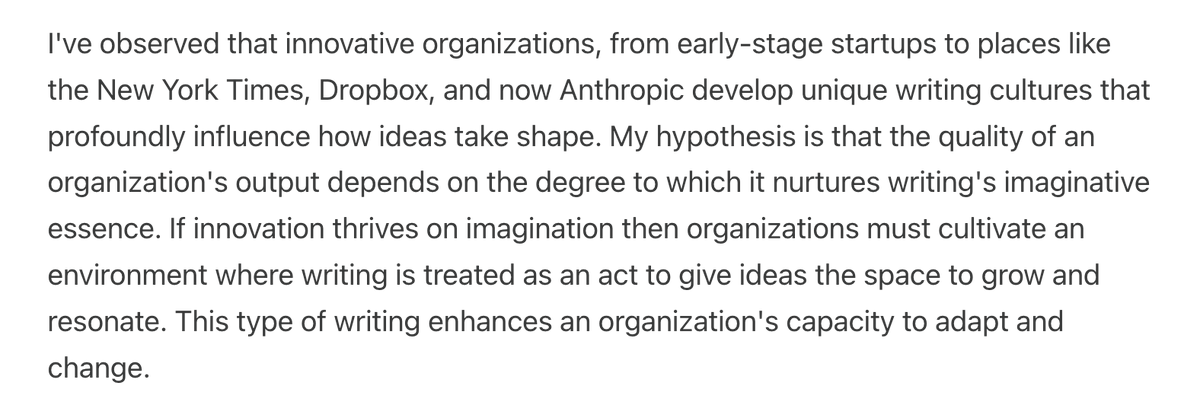
not every successful company has a rich culture around writing, but i’d guess that every genre-defining company does (i.e., anthropic, stripe, and google come to mind)
from this great @karinanguyen piece https://t.co/Y9UKejHyqY https://t.co/WaaGl9Wqjs
The best way to take advantage of ChatGPT Voice.
I am completely and utterly voice-pilled. Voice interaction with AI is going to change the way humans interact with computers.
Here's what you can do:
1. Create a remote connection to an always-on desktop PC through the ChatGPT Desktop app (I have a Linux box in my basement)
2. Customize the ChatGPT iOS widget and add a remote voice connection
3. Tap the widget. It will open a voice chat in ChatGPT Work/Codex, on your desktop, with access to your files and all your apps.
It's like an always on Jarvis that has its own computer.
Amazing stuff. Try it out!
 Watch on X
Search and filters always cover the full archive.